
Table of Contents:
Core Trading Concepts: From Barter Systems to Modern Financial Markets
Trading is one of humanity's oldest economic activities, predating money itself by thousands of years. The earliest recorded barter systems emerged around 6000 BCE in Mesopotamia, where merchants exchanged grain for livestock or tools — a fundamentally simple concept that still underpins every transaction executed on the NYSE or Binance today. What has changed dramatically is not the core principle of exchange, but the infrastructure, speed, and instruments through which that exchange occurs. Understanding this evolution is not merely academic; it shapes how you interpret price discovery, liquidity, and market behavior in live trading environments.
The Mechanics of Value Exchange
At its most fundamental level, trading involves two parties who disagree on value — and that disagreement is the engine of every market. A buyer believes an asset is worth more than the current price; a seller believes it is worth less, or needs liquidity immediately. This tension creates price discovery, the continuous process by which markets establish fair value. Whether you're explaining this to a newcomer — as resources like a simple breakdown of what trading actually means can illustrate — or refining your own execution strategy, this asymmetry of opinion is what generates opportunity.
Currency standardization in ancient Lydia around 600 BCE was arguably the first major "market structure" upgrade in history. By introducing stamped metal coins, traders eliminated the double coincidence of wants problem inherent in barter: you no longer needed to find someone who both had what you wanted and wanted what you had. Modern equivalents of this structural upgrade include the introduction of central counterparty clearing houses (CCPs) in the 19th century, which eliminated bilateral counterparty risk and made large-scale securities trading viable.
From Regional Markets to Global Trading Ecosystems
The formation of organized trading groups accelerated market reach exponentially. When nations began establishing formal trade agreements, entire economic blocs emerged — and understanding how regional trade alliances function and distort market dynamics remains essential for anyone trading currency pairs or commodities affected by tariff regimes. The EU single market, NAFTA/USMCA, and ASEAN collectively represent trillions in annual trade flows that directly influence forex and equity valuations.
Electronic trading, introduced at scale with the NASDAQ's launch in 1971 as the world's first electronic stock market, democratized access in ways that continue to accelerate. By 2023, retail traders accounted for roughly 25% of U.S. equity market volume — a structural shift driven by zero-commission brokers and mobile execution platforms. The explosive growth of individual market participants has fundamentally altered intraday volatility patterns, particularly around earnings events and meme-stock cycles.
Digital assets represent the most recent structural evolution, compressing centuries of financial infrastructure development into a decade. Bitcoin's emergence in 2009 introduced decentralized, permissionless value transfer — a concept that, once you cut through the noise, mirrors the original function of barter but with programmable settlement. For practitioners looking to integrate this asset class into a broader portfolio framework, understanding how cryptocurrency markets actually operate beneath the surface is prerequisite knowledge, not optional reading.
- Price discovery requires sufficient liquidity — thin markets produce erratic, unreliable signals
- Market structure determines execution quality: ECNs, dark pools, and market makers each create different fill environments
- Regulatory frameworks (MiFID II, Reg NMS) govern how orders route and how transparency obligations apply
- Asset class correlation shifts during crisis periods — historical barter logic of intrinsic value re-emerges in commodities during equity drawdowns
The throughline from Mesopotamian grain markets to algorithmic HFT firms is not technology — it is human behavior under uncertainty. Every bid-ask spread, every limit order queue, every momentum spike reflects the same underlying drivers of greed, fear, and information asymmetry that characterized a Phoenician trader weighing silver in 900 BCE. Mastery begins with internalizing this continuity.
Technical Analysis Toolkit: Charts, Trendlines, and Moving Averages in Practice
Technical analysis is not about predicting the future — it's about reading the present state of market sentiment through price action. The raw material you work with is the price chart, and your ability to extract meaningful signals from it separates systematic traders from those who react emotionally to every candle. Most professional traders operate with a core set of tools that are deliberately kept small: cluttered charts produce analysis paralysis, not better decisions.
Reading Charts with Purpose
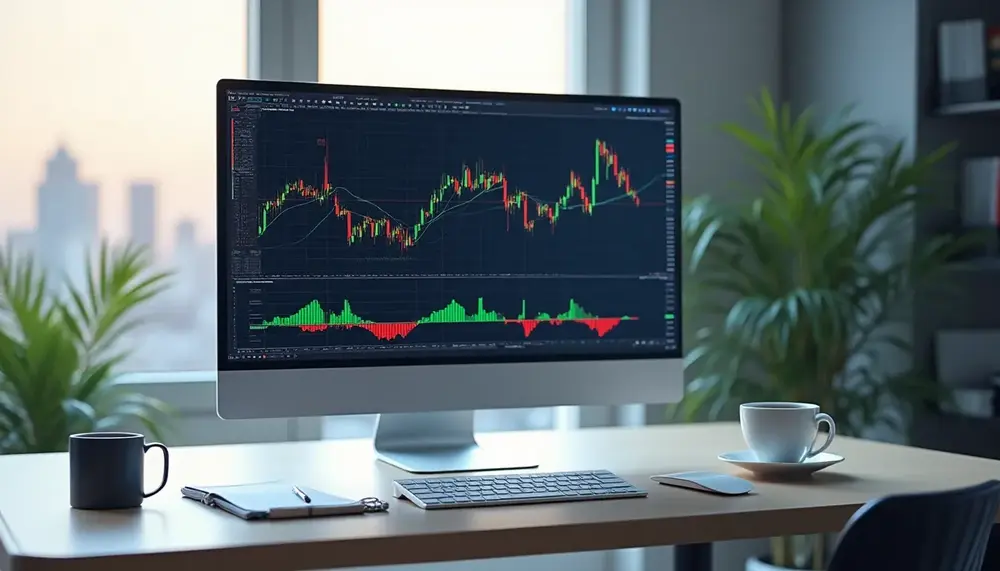
Candlestick charts remain the industry standard for good reason. Each candle encodes four critical data points — open, high, low, and close — giving you an immediate visual impression of buying and selling pressure within any given timeframe. A daily chart on EUR/USD showing three consecutive bullish candles closing near their highs communicates a very different story than three candles with long upper wicks, even if the net price movement looks identical on a line chart. When you're building your analytical workflow, choosing the right platform matters as much as choosing the right indicator. Platforms built specifically for technical analysis offer multi-timeframe layouts, custom alerts, and community-shared scripts that accelerate your learning curve significantly.
Multi-timeframe analysis is a non-negotiable discipline. A trader looking at the 15-minute chart in isolation is like navigating a city using only a street-level photograph. The standard approach used by swing traders is to establish the dominant trend on the weekly or daily chart, identify structure and key levels on the 4-hour chart, and then execute on the 1-hour or 15-minute chart. This top-down method keeps your entries aligned with higher-probability directional bias.
Trendlines and Moving Averages as Decision Tools
Trendlines are one of the most abused tools in retail trading — drawn arbitrarily through noise rather than anchored to significant swing highs and swing lows. A valid uptrend line connects at least two confirmed swing lows, with each subsequent low being higher than the last. The practical value of drawing trendlines correctly lies not in the line itself, but in identifying the precise price zone where buyers have historically defended the trend, giving you a structured area to look for long entries with defined risk.
Moving averages serve a dual function: they smooth out price noise and act as dynamic support and resistance. The most battle-tested combinations in professional environments are:
- 20 EMA — momentum filter; price above signals active buying pressure
- 50 EMA — intermediate trend reference, widely watched by institutional desks
- 200 SMA — the long-term dividing line between bull and bear market structure
The 200 SMA on the daily chart is particularly powerful because it functions as a self-fulfilling level — so many participants react to it that price frequently stalls, reverses, or consolidates around it. Understanding how moving averages transform raw price data into actionable trend signals helps you avoid the common mistake of treating them as mechanical buy/sell triggers rather than contextual filters.
Ultimately, the goal is not to collect tools but to build a repeatable decision framework. A trendline break confirmed by a close below the 50 EMA on elevated volume tells a coherent story — one piece of evidence reinforcing another. Structuring your analysis around a defined trading setup transforms these individual signals into a systematic edge rather than a collection of disconnected observations.
Risk Management and Trading Discipline: Protecting Capital in Volatile Markets
Most traders blow their accounts not because they lack a profitable strategy, but because they fail to manage risk consistently. The mathematics are unforgiving: a 50% drawdown requires a 100% gain just to break even. Understanding this asymmetry is the foundation of professional trading. The primary objective for any serious trader is capital preservation — profits follow naturally when losses are controlled.
Position Sizing and Stop-Loss Placement
The industry standard for risk per trade sits between 1% and 2% of total account equity. A trader with a $50,000 account should rarely risk more than $1,000 on a single position. This isn't arbitrary conservatism — it's what allows you to survive a string of 10 consecutive losses without catastrophic damage. Many professionals apply the Kelly Criterion as a mathematical framework for position sizing, though most use a fractional Kelly (typically 25–50%) to reduce variance during drawdown periods.
Stop-loss placement should be technically driven, not emotionally arbitrary. Placing stops just below key support levels, recent swing lows, or beyond the Average True Range (ATR) — typically 1.5x to 2x ATR — keeps you out of market noise while limiting exposure. A well-structured approach to preserving account equity through systematic risk controls separates professionals from amateurs across every asset class and timeframe.
- Risk-to-reward ratio: Only enter trades offering at least 1:2 — risking $500 to make $1,000 minimum
- Maximum daily loss limit: Cap losses at 5–6% of account per day before stepping away from the screen
- Correlation risk: Avoid holding multiple positions in highly correlated assets simultaneously — they amplify drawdowns
- Volatility-adjusted sizing: Reduce position size during high-VIX periods or around major economic announcements
Discipline as a Systematic Edge
Technical knowledge means nothing without the behavioral consistency to apply it under pressure. Revenge trading — the impulse to immediately recoup losses with oversized positions — is statistically one of the most destructive patterns in retail trading. After a losing trade, the disciplined response is to review the trade against your rules, not to override them. The psychological edge that separates consistently profitable traders from the rest is rarely discussed in strategy forums, yet it drives the majority of long-term performance differences.
For traders managing volatility across entries, scaling into positions using cost-averaging techniques can smooth entry prices during trending markets — but this requires strict rules to prevent averaging into a losing trade indefinitely. Define your maximum position size upfront and stick to it regardless of conviction level. When discipline breaks down repeatedly at specific decision points, consider whether rule-based algorithmic execution might remove the emotional variable entirely from your workflow.
Keeping a detailed trading journal — recording not just entries and exits, but emotional state, rationale, and deviations from the plan — reveals behavioral patterns invisible in raw P&L data. Review it weekly. Traders who journal consistently identify their own worst habits within 30–60 days and can systematically eliminate them. This iterative process of self-correction, grounded in data rather than gut feeling, is what transforms a losing trader into a consistently disciplined one.
Crypto vs. Forex vs. DeFi: Comparing Market Structures and Trading Opportunities
Choosing the right market isn't just a matter of preference — it fundamentally determines which strategies work, what risks you face, and how much capital you actually need to trade competitively. The forex market processes roughly $7.5 trillion in daily volume, making it the most liquid financial market on earth. Crypto markets, by comparison, handle somewhere between $50–100 billion on active days. DeFi protocols settle significantly less, but the structural differences between all three markets create entirely distinct trading environments that reward different skill sets.
Market Structure: Where the Real Differences Live
Forex operates as an over-the-counter (OTC) interbank market, meaning there's no central exchange. Prices are set by a network of major banks — JP Morgan, Deutsche Bank, Citi — and retail traders access this liquidity through brokers who act as market makers or route orders via ECN/STP connections. This creates tight spreads on major pairs like EUR/USD (often 0.1–0.5 pips) but also introduces counterparty risk and the possibility of broker manipulation. If you're deciding between these asset classes, a direct comparison of how crypto and forex markets actually operate reveals structural nuances that most beginner guides skip entirely.
Crypto markets, by contrast, are exchange-based and largely transparent. Order books on Binance, Coinbase, or Kraken are publicly visible. This transparency cuts both ways: sophisticated traders can read the order book and spot large limit orders acting as support or resistance, but it also means large players can see your stops being clustered around obvious levels. Unlike forex, crypto markets never close — weekend trading in particular exposes retail traders to low-liquidity moves that wouldn't be possible in a structured market session.
DeFi trading operates through automated market makers (AMMs) like Uniswap or Curve, replacing traditional order books with liquidity pools governed by mathematical formulas. This creates unique phenomena like impermanent loss for liquidity providers and on-chain price discovery that's deliberately exploited by MEV bots. Understanding what DeFi trading actually means for active market participants is essential before allocating capital to any protocol — the risks are categorically different from anything in traditional finance.
Trading Opportunities and Realistic Edge
Forex excels for trend-following and macroeconomic strategies. Currency pairs like GBP/JPY or USD/MXN respond predictably to central bank decisions, inflation data, and geopolitical shifts — giving fundamental traders a genuine informational edge. Crypto markets, particularly smaller altcoins with lower market caps, offer asymmetric momentum plays that simply don't exist in mature currency pairs. A $50M market cap token can 10x on legitimate adoption news; EUR/USD will not.
One critical risk factor that applies unevenly across markets is information asymmetry. In crypto, the regulatory framework around privileged information and market manipulation remains far weaker than in forex or equities, meaning on-chain data analysis and wallet tracking have become legitimate forms of edge that don't exist in traditional markets.
- Forex strengths: Deep liquidity, tight spreads, well-defined session-based volatility patterns
- Crypto strengths: 24/7 access, asymmetric upside on emerging assets, transparent on-chain data
- DeFi strengths: Non-custodial execution, yield strategies impossible in traditional finance, permissionless access
- DeFi risks: Smart contract exploits, gas cost friction, MEV front-running on every on-chain transaction
Experienced traders often operate across all three markets simultaneously, using forex for disciplined macro exposure, crypto for high-conviction momentum trades, and DeFi selectively for yield strategies when on-chain conditions justify the smart contract risk. The mistake most developing traders make is committing entirely to one market before understanding the structural mechanics of each.
Crypto Wallet Infrastructure: Security, Anonymity, and Asset Management
Your wallet infrastructure is the single most critical component of your crypto trading setup — and consistently the most neglected. Traders spend hours analyzing charts but minutes choosing where to store five-figure positions. The reality is that exchange hacks, phishing attacks, and smart contract exploits have drained over $3.8 billion from poorly secured holdings in 2022 alone. Building a robust wallet architecture is not optional; it's the foundation of sustainable trading.
Choosing the Right Wallet Architecture
The first decision every serious trader must make is the hot/cold split. Hot wallets — software-based, internet-connected — are essential for active trading but should never hold more than you're prepared to lose in a single session. Cold wallets like Ledger Nano X or Trezor Model T keep private keys offline and are appropriate for long-term holdings exceeding 20-30% of your total portfolio. A practical benchmark: if a position will sit untouched for more than two weeks, it belongs in cold storage. For a comprehensive breakdown of which solutions actually hold up under real-world conditions, reviewing the most reliable options for protecting your crypto assets is an essential starting point before committing to any infrastructure.
Beyond hardware versus software, traders must understand wallet address architecture — the mechanics of how funds are received, identified, and traced on-chain. Each wallet generates a unique alphanumeric identifier derived from your public key. Understanding exactly how these cryptographic addresses function and what they reveal directly impacts how you manage transaction privacy and portfolio attribution. Many traders unknowingly consolidate addresses in ways that expose their entire holdings to chain analysis tools.
Privacy, Anonymity, and Regulatory Considerations
KYC requirements have expanded dramatically across centralized exchanges since 2021. Binance, Coinbase, and Kraken now require full identity verification for withdrawals exceeding $1,000 in many jurisdictions. For traders with legitimate privacy concerns — journalists, high-net-worth individuals in politically unstable regions, or those managing business treasury — non-custodial wallets that operate without identity verification offer a legally compliant alternative in most jurisdictions. Tools like Exodus, Electrum, or Monero-based wallets enable asset management without linking transactions to a government-issued identity.
Withdrawal capabilities vary dramatically across wallet types and deserve specific attention before you're under time pressure. Some wallets impose daily limits, require multi-signature approval for large transfers, or restrict access to specific blockchain networks. Understanding how to configure your wallet for maximum withdrawal flexibility becomes critical during volatile markets when speed matters. A multi-sig setup requiring 2-of-3 key signatures, for example, adds security but can delay a time-sensitive exit by 10-15 minutes — a meaningful window during a flash crash.
Implement these structural safeguards as non-negotiables:
- Seed phrase storage: Engrave on steel, never photograph or store digitally — Cryptosteel and Bilodal offer purpose-built solutions
- Address whitelisting: Enable on all exchanges to prevent unauthorized withdrawal destinations
- Network segregation: Maintain separate wallets for EVM-compatible chains versus Bitcoin — cross-chain confusion is a leading cause of irreversible fund loss
- Regular audit cycles: Review connected dApps and revoke unused approvals monthly using tools like Revoke.cash or Etherscan's token approval checker
The traders who survive long-term treat wallet infrastructure as seriously as position sizing. A 2% drawdown is recoverable; a compromised private key is not.
Regulatory Frameworks and Legal Compliance Across Trading Markets
Regulatory compliance is not a checkbox exercise — it is a fundamental component of sustainable trading. Markets operate within overlapping jurisdictions, and traders who ignore the legal architecture governing their activity expose themselves to account freezes, tax penalties, and outright criminal liability. The regulatory landscape varies dramatically between asset classes: equity markets in the U.S. fall under SEC oversight with standardized reporting requirements, while derivatives markets are governed by the CFTC, each with distinct margin rules, disclosure obligations, and investor protections.
Crypto Regulation: A Fragmented Global Reality
Cryptocurrency regulation remains the most complex and rapidly evolving area for traders to navigate. Jurisdictions are not converging — they are diverging. The EU's MiCA framework (Markets in Crypto-Assets Regulation), which came into full effect in 2024, requires crypto asset service providers to obtain authorization and maintain capital reserves, fundamentally reshaping how European traders access exchanges. Meanwhile, U.S. regulators continue debating whether tokens constitute securities under the Howey Test, creating genuine legal uncertainty. Anyone actively trading Bitcoin or altcoins should understand the evolving legal obligations that govern crypto market participants, including AML (Anti-Money Laundering) requirements and exchange licensing status in their jurisdiction.
Tax treatment of crypto gains is equally inconsistent across borders and frequently misunderstood. In the Philippines, for example, the Bureau of Internal Revenue classifies crypto gains as ordinary income subject to progressive tax rates up to 35%, with exchange transactions potentially triggering VAT obligations. Traders operating in Southeast Asian markets should study the specific tax mechanics applicable to crypto investors in the Philippines to avoid inadvertent non-compliance that accumulates silently over time.
Identity Verification, Religious Compliance, and Structural Considerations
KYC (Know Your Customer) and AML compliance requirements now apply to virtually every regulated trading venue globally. FATF (Financial Action Task Force) guidelines mandate that exchanges collect and verify user identity above minimal transaction thresholds — typically $1,000 USD equivalent. The practical implication: trading through unverified accounts creates legal exposure, and exchanges operating without proper licensing may be seized or shut down, leaving traders with no legal recourse. Those curious about how verification-free trading actually works and where it remains legally permissible will find the reality significantly more constrained than commonly advertised.
For traders in Muslim-majority markets or individuals following Islamic finance principles, regulatory compliance intersects with Sharia compliance. Conventional margin trading and certain derivative instruments involve riba (interest), which is prohibited under Islamic law. Several regulated brokers now offer swap-free accounts specifically structured for this demographic — a product category growing particularly in Malaysia, Indonesia, and the GCC. The question of whether spot and derivative crypto trading meets Halal standards depends heavily on both the instrument structure and the scholarly authority consulted.
Practical compliance steps every serious trader should implement include:
- Verify that your broker or exchange holds a valid license from a recognized authority (FCA, ASIC, CySEC, MAS)
- Maintain complete transaction records for a minimum of five years — the standard audit window in most jurisdictions
- Consult a tax professional familiar with cross-border crypto transactions if you use exchanges domiciled outside your home country
- Review your broker's segregated fund policy — MiFID II requires client funds to be held separately from operational capital
- Understand whether your instruments are classified as CFDs, which carry additional leverage restrictions in regulated EU and UK markets
Regulatory frameworks are not static. The SEC's ongoing litigation against major exchanges, India's shifting GST treatment of crypto, and Australia's proposed licensing regime for digital asset platforms all demonstrate that compliance requirements demand quarterly review, not annual attention. Traders who treat regulatory literacy as a one-time study exercise systematically underestimate their exposure.
FAQ zu Trading Education Essentials
What is the importance of trading education?
Trading education is crucial for developing a systematic understanding of market structure, risk management, and psychological discipline. It helps traders build a strong foundation to navigate the complexities of financial markets.
How can I start learning about trading?
Beginners can start learning about trading by reading books, taking online courses, and following reputable trading forums and websites. It's essential to focus on systematic strategies rather than relying solely on market predictions.
What are some common trading strategies?
Common trading strategies include day trading, swing trading, scalping, and position trading. Each strategy has its own unique approach to market analysis and risk management, catering to different trader profiles.
Why is risk management critical in trading?
Risk management is critical in trading because it helps protect capital from significant losses. A structured approach to position sizing and stop-loss placement can ensure traders remain in the market longer and improve long-term profitability.
How can I improve my trading discipline?
Improving trading discipline involves maintaining a trading journal, sticking to a defined trading plan, and reviewing past trades to identify emotional patterns. Consistent practice and self-awareness are key to becoming a disciplined trader.